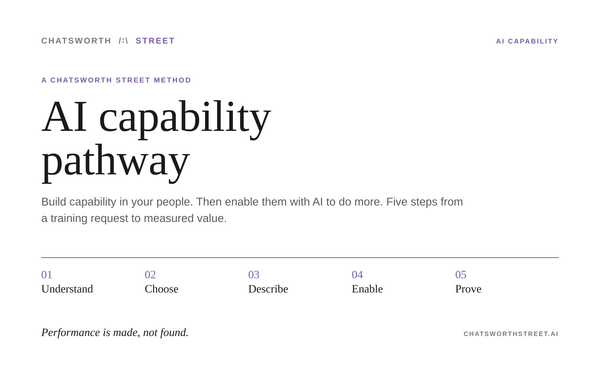
Performance is made, not found
Why Chatsworth Street exists — and the one sequence most organisations get backwards.
Why Chatsworth Street exists — and the one sequence most organisations get backwards.
SECTION ONE
Why this matters
Most organisations approach technology backwards.
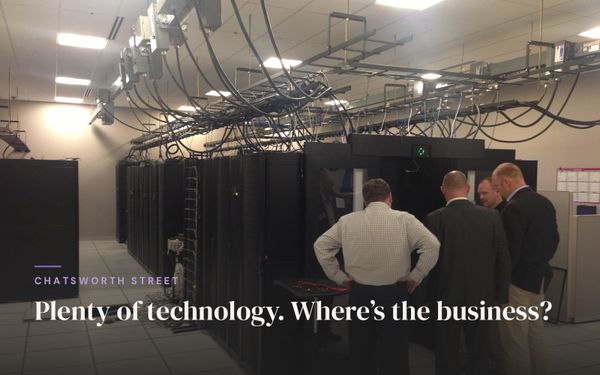
The tool comes first. A platform gets chosen, a licence gets signed, a programme gets a name, and then the work quietly bends to fit whatever the tool can do. By the time anyone asks what problem they were solving, the answer has already been shaped by the technology that was meant to serve it.
I built Chatsworth Street to run the sequence the other way.
Name the problem first. Fix the work. Then, and only then, reach for the technology.
Written down it sounds obvious. In practice almost nobody holds it, because holding it means saying no to the tool everyone is excited about until the work underneath it is sound.
That discipline is the whole business. Get the order right and the answer gets cheaper, simpler, and easier to defend. Get it wrong and you spend good money automating a mess.
The tool is never the strategy. The tool is what you reach for once the strategy is sound.
SECTION TWO
The shifts
The same decision looks completely different depending on where you start. Begin with the tool and the cost climbs while the problem stays fuzzy. Begin with the problem and the expensive answer usually turns out to be the wrong one.
| The question | Tool-first | Problem-first |
|---|---|---|
| Where you start | Which platform do we buy? | What problem are we actually solving? |
| Where the cost goes | Up — every gap gets another tool | Down — one clear problem, one clear answer |
| What scales | The licence count | The capability |
| What you can defend | The vendor’s roadmap | The decision itself |
I’ve watched this play out across infrastructure, cloud, and operating-model work for the better part of two decades. The pattern doesn’t vary. When the problem is named correctly, the solution is almost always smaller than the one everyone assumed they needed.
SECTION THREE
What changes when you put the problem first
Five principles do the work. None of them is decoration.
|
1
Problem first
|
Problem before tool. Anchor every decision to a defined problem before any platform, framework, or technology is in play. A tool reached for too early reshapes the work to suit itself. |
|
2
Name it right
|
Name it correctly and the cost collapses. When the framing is right, the answer turns out cheaper, more scalable, and more defensible than the tool-first version. If the recommendation looks expensive and difficult, the framing is probably still wrong. |
|
3
Platform
|
Look for the platform, not just the pipeline. A pipeline optimises a chain of activities. A platform orchestrates participants so value compounds as more of them join. Over time, the platform wins — so we look for it in the problem. |
|
4
Choices
|
Strategy is a set of choices, including the refusals. A strategy is the set of choices that raise the odds of winning. What you refuse matters as much as what you commit to. We name both. |
|
5
Order
|
Order before automation. Fix the workflow, then automate it, then measure it, then assure it. A tool laid on top of broken work only amplifies the breakage. |
SECTION FOUR
Where people get it wrong
Four assumptions I hear constantly — and what’s actually true.
| “We need a digital transformation.” | → | Name what’s broken first. Transformation, if it’s even the right word, is what happens after. |
| “The best tool will fix this.” | → | A tool on broken work amplifies the breakage. It doesn’t repair it. |
| “More technology means more capability.” | → | Capability is people and process. Technology sits on top of both, not in place of either. |
| “Strategy is the plan.” | → | Strategy is the set of choices — including what you refuse. A plan with no refusals is a wish list. |
SECTION FIVE
How we think about it
Chatsworth Street is one founder and two practices. Productivity is operating-model design — getting the work itself right: value, journey, process, policy, evaluation. TasCyber is digital risk, capability, and assurance — Risk → Capability → Assurance. Different problems, same method underneath: name the problem, fix the work, then apply the technology.
And you get the founder, directly. Same person, same standards, less scaffolding. No layer of account managers between the thinking and the work.
Performance isn’t something you find — bought off a shelf, hired into a role, or installed through a programme. It’s something you make, by getting the work right before you spend a dollar making it faster.
Performance is made, not found.
NEXT STEP
Let’s talk
If you’re weighing up a technology decision and you’re not yet sure the problem underneath it has been named properly, that’s the conversation worth having first.
Start a conversation: hello@chatsworthstreet.ai.
Performance is made, not found.
Chatsworth Street · Tasmania, Australia · hello@chatsworthstreet.ai · chatsworthstreet.ai