The AI capability pathway
The request usually arrives as "train our people on AI". The more useful version asks where AI belongs in the work, what capability that opens, and how to prove it was worth doing.
The request usually arrives as "train our people on AI". The more useful version asks where AI belongs in the work, what capability that opens, and how to prove it was worth doing.
Most AI training answers the wrong question. It teaches tips that are forgotten within a fortnight, because none of it attaches to anything anyone actually does. Meanwhile, AI is already in the work, further in than most organisations think, arriving one workflow at a time on a credit card, with the changed work, the supervision, and the checking never reaching the invoice.
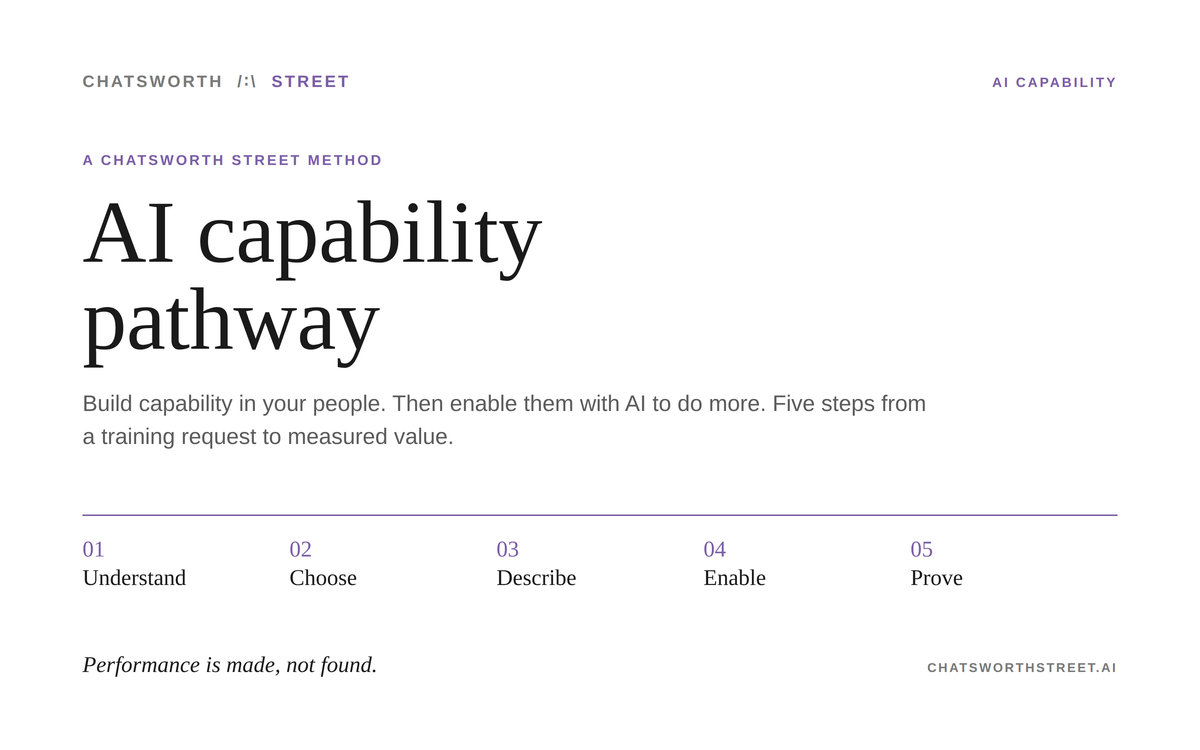
So the honest answer is not a course. It is a pathway. Build capability in your people, decide where AI belongs, and only then enable them with a tool. Five steps take a training request through to measured value, and each one does useful work on its own. What follows is the map. Read it as a set of decisions, not a maturity ladder.
Why this exists
Why not just provide AI training?
Training decays. Twenty-five chatbot tricks are forgotten in a fortnight, because none of it attaches to anything anyone actually does.
It is already here. Most organisations use AI informally, further into the work than they think. Nothing gated it, because there was nothing to procure.
The cost is hidden. AI can arrive on a credit card. Much of what it really costs, the changed work, the supervision, the checking, never reaches the invoice.
How far are we prepared to let AI take part in our work? Everything else follows from this.
Where AI sits in the work
Four positions
These are positions, not stages. Further in is not better. What changes is where accountability sits, and how much has to exist around the work.
Outside the work. AI helps a person. They still do the job and decide.
Beside the work. AI prepares and checks. A person still performs the step.
Inside the work. AI performs a defined step. A person owns the mechanism.
Makes the call on its own. AI decides inside set limits. A person sets and supervises them.
In the first two positions, accountability never moves. In the last two it does, and it has to be placed deliberately.
The further in AI goes, the more must exist around it.
The pathway
From a training request to measured value
The five steps run in order, but each earns its place alone. Every step produces something useful, and surfaces the next capability the organisation has to build.
| 01 | Understand. Where should AI participate? Nobody decides how far AI goes into the work, they find out later. Map where AI already sits, build shared language and safe use, and name what always stays human. You get an honest picture of current use and a written list of refusals. The gap it surfaces is leadership: deciding where AI belongs, and what is never handed over. |
| 02 | Choose. Which work is worth changing? Generic exercises produce enthusiasm. Real work produces evidence. Pick one piece of work, agree how far AI participates, and measure today's time and cost. You get one use case, an agreed level of participation, and a baseline. The gap it surfaces is workforce: judging consequence, and knowing what the work costs today. |
| 03 | Describe. What exactly should happen? A new employee tells you when they do not understand the work. AI fills the gap instead. Write the work down first, set the inputs, checks and escalation, and name the accountable role. You get a clear description of the work, its boundaries, and someone who answers for it. The gap it surfaces is process: describing work clearly enough to hand it over. |
| 04 | Enable. Which tool, configured how? Choose the tool against the work, not the work against the tool. Select it for the work, configure it for that work, and train people in their real jobs. You get people who can do the work with AI, on a tool you have approved. The gap it surfaces is technology: selecting against a described requirement, not a product. |
| 05 | Prove. Did it create value? Did it do what you said it would, and was it worth doing? Measure against the baseline, test that it stayed inside its boundary, and count both sides of the cost. You get evidence, and a decision about what happens next. The gap it surfaces is assurance: testing whether AI stayed inside the boundary it was given. |
Stop at any step, or continue. You do not need to commit to all five.
How to begin
Start with Understand
Start here. Understand stands alone, as an executive and staff capability engagement. It ends in a decision about where AI belongs and what stays human.
Then, on the evidence. Choose, Describe, Enable and Prove take one real use case through to measured value. Take it one step at a time, or run the whole pathway.
Stay outside the work and two gaps stay open, both modest. Let AI make the call on its own and all five open, and one of them is a capability the organisation has probably never had.
Performance is made, not found.
Chatsworth Street · hello@chatsworthstreet.ai · chatsworthstreet.ai